The Five Dysfunctions of a Team
Why we’re covering Patrick Lencioni’s Five Dysfunctions of a Team
Patrick Lencioni’s Five Dysfunctions of a Team is on every list of books to read for team dynamics. And there’s a hidden reason.
Because it’s not just a how-to book that ignores real life.
It’s written as a fable of sorts. The book’s first part takes you through the changeover in leadership and how it impacts the key players.
You watch, like a fly on the wall, the way that new leadership comes in to shape the team. The team isn’t working - and it’s hard to assess why. And rather than a laundry list of “how-to’s” you see a “how-done’s” - including people freaking out, quitting, reorg-ing, etc.
That’s why the book is so good. So often with personal and professional development books they’re created as a snapshot - a moment in time that can be impacted and improved if you commit.
This book considers the reality of how to get a leadership team re-aligned and how annoying it is - how they complain about how much work it is - how frustrated they all are.
What is the core lesson?
It’s all about the five behaviors necessary for a high-functioning team - and what it looks like to be at a loss.
“The fact remains that teams, because they are made up of imperfect human beings, are inherently dysfunctional.”
This shows up all time the time in my work - most of us love work, but our struggles are with the people. Sartre taught us that. “Hell is other people.”
Part of work is the other people part. So how do you make it work?! You learn what creates a strong team and work towards it.
How members of a truly cohesive team behave:
They trust one another
They engage in unfiltered conflict around ideas
They commit to decisions and plans of action
They hold one another accountable for delivering against those plans
They focus on the achievement of collective results
What does a dysfunctional team look like?
There are few quick ways to identify if a team isn’t working well - there are a couple behaviors you may see:
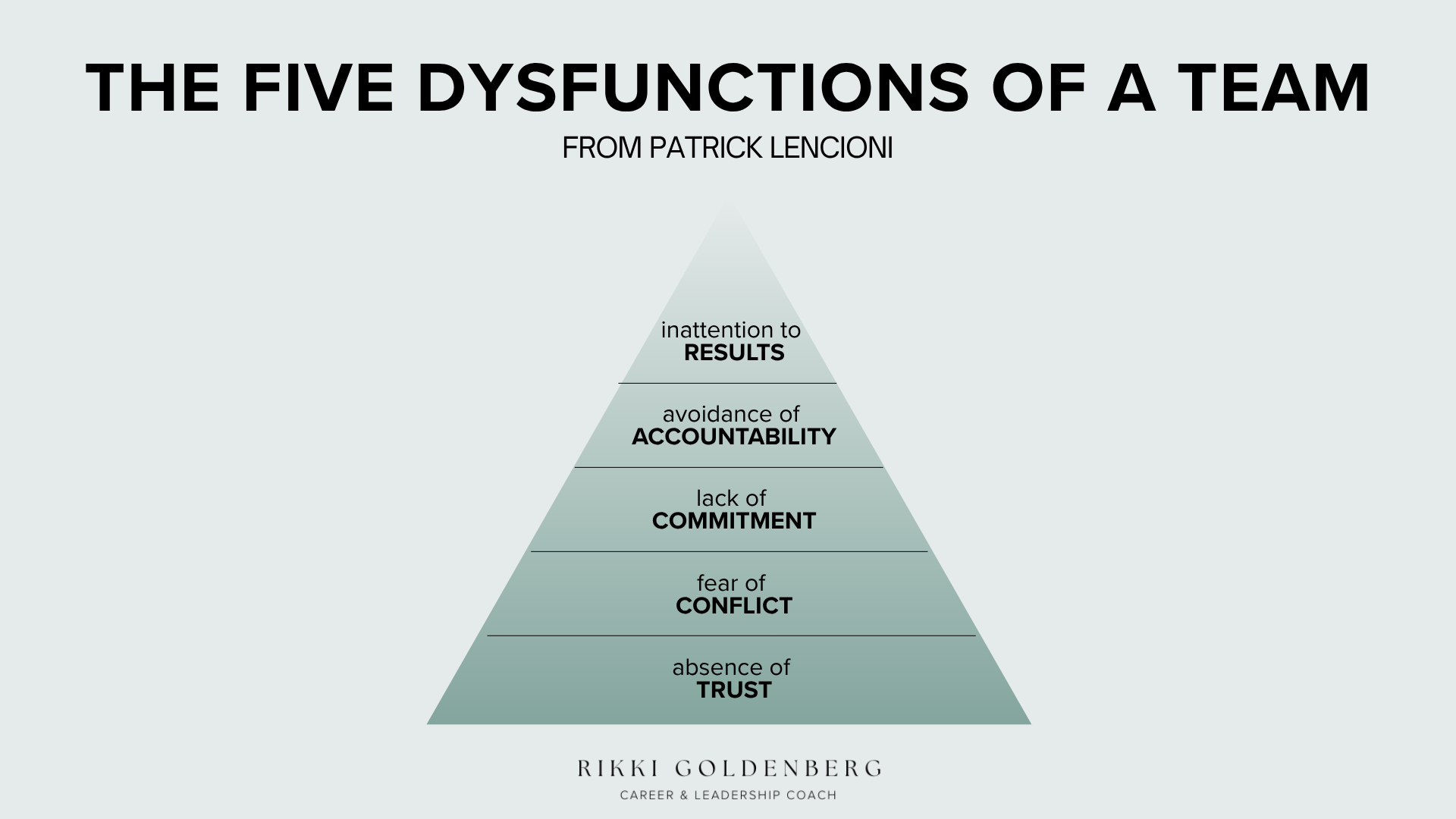
Absence of Trust - you can see this if there’s an unwillingness to be vulnerable within the group. You end up with team members who are not genuinely open with one another about their mistakes and weaknesses make it impossible to build a foundation for trust. They’re hesitant to ask for help, provide constructive feedback, they have a hard time offering help. They might jump to conclusions and forget about everyone’s lived experiences and skills. They likely hold grudges, and avoid spending time together. This is the foundation for most team’s dysfunctions. Trust is hard-earned, and quickly lost. It’s difficult to repair and rebuild, and yet, it’s ESSENTIAL to success.
Fear of Conflict - without trust at the core, we can’t have healthy conflict. Teams that lack trust are incapable of engaging in unfiltered and passionate debate of ideas. Instead, they resort to veiled discussion and guarded comments. Conflict is considered taboo - and the higher up you go, the more you’ll see people avoiding those wildly passionate debates. And, many of us are uncomfortable with any expression of conflict and try to mediate and harmonize - sometimes the conflict is good for the team!
Lack of Commitment - without having aired their opinions through passionate and open debate, team members rarely, if ever, buy in and commit to decisions, though they may feign agreement during meetings. Basically since we don’t trust each other and we’re avoiding healthy discourse - we have a hard time agreeing to to things fully. Instead we half-commit - “of course susan I’ll work on that I agree”… when we know it’s not real. And we’re going to skip it.
Avoidance of Accountability - Because of this lack of real commitment and buy-in, team members develop an avoidance of accountability, the fourth dysfunction. Without committing to a clear plan of action, even the most focused and driven people often hesitate to call their peers on actions and behaviors that seem counterproductive to the good of the team.
Inattention to Results - failure to hold one another accountable creates an environment where the fifth dysfunction can thrive. Inattention to results occurs when team members put their individual needs (such as ego, career development, or, recognition) or even the needs of their departments above the collective goals of the team.
It’s important to remind ourselves that this is NORMAL. Most teams has dysfunctions. Because humans are fickle. They’re unique. They’re weirdos! But there’s work to be done. That can be done.
How to overcome dysfunctions on your team
If your team suffers from an absence of trust try…
Spending time on learning about people’s origin stories - where they grew up, what their childhood was like, what was their first job! At Bigwig, we do “1 minute with” a rapid-fire list of questions that we ask folks things like, where do you get your best ideas?!
Personality profiles to have shared language - I’m a sucker for strengthsfinder, but MBTI, DISC, any buzzfeed style quiz that has silly results is good. Recently I experienced Interpersonal Leadership Styles which was fab, too!
360 degree feedback outside of performance reviews - I.e. a place to solicit real feedback and support outside of it impacting your score/promotion/bonus - space to have open dialogue and learnings
If your team suffers from fear of conflict try…
Real time permission - i.e. saying, hey, let’s create a space to argue a bit - not to dig our heels in, but to help highlight our different opinions. It might get a little heated or uncomfortable, but we’re not doing any direct aggression - it’s in service of the work, and our beliefs need space to be aired!
If your team suffers from lack of commitment try…
Cascading messaging - at the close of meetings, clarify exactly who needs to be told what, and what needs to remain confidential
Low risk “exposure therapy” - make decisive agreements on lower risk tasks to show how it’s possible
If your team suffers from avoidance of accountability try…
Have goals and standards public - make it clear what the goal is and what good looks like
Simple and regular process reviews - space to consistently review and discuss how we’re doing on our objectives and how we’re meeting our standards (or not!)
Team rewards - rewarding the whole team for successful moments, not just individuals
If your team suffers from inattention to results try…
Public declaration of results - not just the goals, but make it good and OKAY to see how we did against those goals!
Results based rewards - supporting how it went down
There’s one things we forget when we look to repair and rebuild a functional team. Want to guess?
The time commitment is no joke
We’re all like okay great - we got this let’s GO. The reality? This takes SO much time to spend active productive time together. In the book they outline it as the following:
annual planning meetings - 3 days offsite: budget, strategic planning, leadership training, succession planning and cascading messaging
quarterly staff meetings - 2 days off site - major goal reviews, financial review, strategic discussion, employee performance discussion, key issue resolution, team development and cascading messages
weekly staff meetings - 2 hours on site- key activity review, goal progress review, sales reviews, customer review, tactical issue resolution, cascading messages
ad hoc topical meetings - 2 hours on site - strategic issues that cannot be adequately discussed during weekly staff meetings
That’s a whole lotta time to commit to this. But, that’s the foundation. That’s how you build it according to Lencioni!
Working to rebuild your team’s functional capacity? Maybe we should chat.